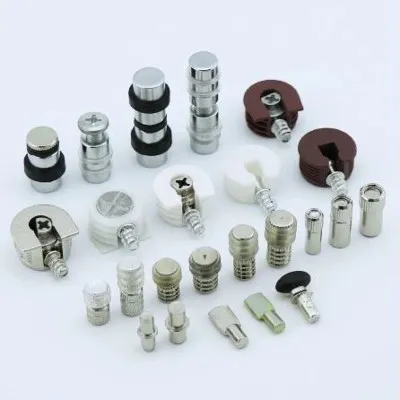

Insert Nuts
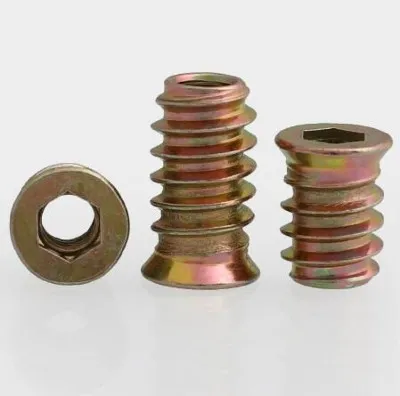
An insert nut provides a threaded socket for a wooden workpiece, similar to a wall anchor. Insert nuts are inserted into a pre-drilled hole by one of two means: screw in and hammer in. In both cases, the external protrusions bite into the wood, preventing the nut from either turning or pulling out.They are threaded internally and externally, the former provides stability for the bolt and the latter provides grip to the object. This also allows the bolt to be easily replaced. Screw-in insert nuts have an external thread and hex head and are screwed in with a Flat Blade Screwdriver or an Allen wrench. The screw-in insert nuts come in various sizes and take different screw sizes. For example, an M6 insert nut will take an M6 bolt, a "1/4-20" insert nut will take a 1/4-20 inch bolt., etc The pre-drilled hole must be as deep as the length of the insert nut plus any portion of the bolt that may be screwed past the end of the nut in the work piece.
Advantages of Insert Nuts
Strong And Durable
Unlike screws and bolts, insert nuts are designed to hold the threads better, resist pull-out forces, and withstand stress and vibration. They provide a more secure and permanent fastening solution for your projects, whether for metal, wood, plastic, or composite materials.
Easy Installation
Insert nuts can be installed with various tools, such as drills, taps, drivers, and pliers, depending on the type and size of the insert. Some inserts don’t require special tools but can be screwed in or hammered in with a mallet. The ease of installation saves time and effort, especially when installing many inserts in a project.
Versatility
Insert nuts come in different materials, such as steel, brass, aluminum, and plastic, to suit various applications and environments. They also come in different shapes and sizes, such as round, hexagonal, square, and flanged, to fit different holes and recesses.
why choose us
Immense experience
Founded in 2006, As an integrated technology corporation whose business covers a coordinated process of design,production and sale, and open mould for new items according to samples or drawings.
Quality safety
Strictly qualified and testing like hardness and calliper before shipping out, ensure customer's quality and delivery time.
Good services&Customized
Devoted to providing better services,lower cost. Welcome customized, accept open mould for new items according to samples or drawings.
Global layout
The product sales footprint covers more than 40 countries on four continents in asia, europe, america and africa.
Importance of insert nut
A insert nut is a small, threaded device that is inserted into a material to create a secure and durable point for attaching bolts or screws. It's essentially a metal sleeve with internal threads that can be easily installed into various materials such as plastic, metal, and wood.
These inserts come in different shapes and sizes, but they all serve the same purpose - to provide a strong anchor point for fasteners. Insert nut are especially useful when it comes to repairing stripped threads or creating new ones where none existed before.
One of the major benefits of using insert nut is their ability to distribute loads over larger areas than standard screws or bolts. This means that they can handle higher stress levels without damaging the material surrounding them.
Insert nut are versatile tools that have many applications in various industries. Whether you're working on automotive repairs, building furniture pieces, or installing electronics components – there's always someplace where including insert nut will make your job easier!
Similar to a wall anchor, an insert nut offers a threaded socket for a wooden object. A pre-drilled hole can insert nuts placed into it using a screw or a hammer. The external protrusions in both situations encroach on the wood and prevent the nut from spinning or drawing out.
They have internal and external threading; the former gives the bolt stability while the latter gives the object grip. Additionally, this makes it simple to replace the bolt.
Compared to barrel nuts and T-nuts, insert nuts are better since they may be placed from just one side of the workpiece.
They give a stronger bond than self-tapping screws and a stronger substitute for weld nuts and tapped holes. In fact, because they were created for automation, threaded inserts are typically the strongest and fastest fasteners utilised in production environments.
Using a insert nut in your hardware projects can offer many benefits that make it an attractive option for both professionals and DIY enthusiasts.
Firstly, using a insert nut can provide added strength to materials that would otherwise be unable to support heavy loads. This is because the insertion of a nut into the material allows for a stronger connection with screws or other fasteners.
Secondly, they are versatile and can be used with various types of materials such as wood, plastic, metal, and even fiberglass. Insert nut come in different sizes and shapes so you can easily find one that suits your needs.
Another benefit of using insert nut is their ability to save time during installation. With traditional methods like welding or tapping threads into metal taking up time-consuming processes, inserting nuts can be quick and easy without any special tools required.
Using insert nut also ensures better accuracy when installing fasteners as they help eliminate cross-threading issues commonly associated with other forms of attachment methods.

How To Install A Insert Nuts
Think about things like the load-bearing requirements and the material thickness. To meet varied applications, nut inserts are available in a variety of thread sizes and materials. Make sure the hole you are using to insert the nut is clear and debris-free. A clean hole encourages better threading and alignment. A tool called a nut insert gun or tool is often needed for nut insert placement. The insert will be properly and evenly inserted in the hole if the right instrument is used. Apply enough force while using the nut insert gun to securely seat the insert. Avoid using too much pressure since it can harm the insert or the fabric. Make that the nut insert is positioned correctly in relation to the hole. Cross-threading and weak connections can happen as a result of alignment issues. Consider whether the base material and the nut insert material are compatible. To avoid galvanic corrosion, select an aluminum nut insert when putting into aluminum, for example. Always adhere to the directions and specifications provided by the manufacturer for the particular nut insert you are using. This will guarantee that you get the outcomes you want and uphold safety regulations.
Fastened components are guaranteed to remain firmly attached thanks to the durable threads that nut inserts produce in a variety of materials. Metals, polymers, and wood are just a few of the materials in which nut inserts can be employed. They are excellent for a variety of applications due to their adaptability. When compared to conventional techniques like welding or thread tapping, installing nut inserts is frequently quicker and more convenient, saving crucial assembly time. Because nut inserts are non-destructive, the material they are placed into is not harmed. When working with sensitive materials or surfaces, this is especially crucial. Nut inserts can be fitted from only one side of the substance, which makes them perfect for applications with restricted access or where the material’s backside is inaccessible. With a balance between durability, strength, and ease of installation, nut inserts are a practical fastening solution.
In the construction of furniture, nut inserts are frequently employed. They make it possible for pieces like drawer slides, knobs, and handles to be attached quickly and securely. Inserts made of nuts provide solidity and durability, ensuring that furniture will hold up over time. In the automotive industry, inserts nut are widely used to attach a variety of equipment, such as dashboard elements, suspension parts, and interior panels.
They are crucial to vehicle assembly because of their capacity to produce powerful threads in thin sheet metal. Accuracy and durability are crucial in the aerospace sector. Nut inserts are used to fasten parts of aircraft, preserving the aircraft’s structural integrity while minimizing total weight. These fasteners offer a strong connection while lowering the chance that delicate materials may be harmed.
Insert nuts are used in the fields of electronics and telecommunications to mount circuit boards, brackets, and different parts inside of apparatus and enclosures. Their meticulous threading guarantees a tight fit and lowers the possibility of loose connections. Nut inserts are also used in building and construction projects. They are employed to fasten items, such as handrails, to metal or concrete buildings. A strong connecting point that can support enormous loads is offered by nut inserts.

Consider the forces in play in the joint where the Insert Nut is to be used. If it’s a fairly lightweight application, an A Type or B Type Knock-in insert will probably be suitable. The main advantage of using these is the simplicity and speed of insertion. They tap into a pre-drilled hole to fix the Insert Nut into the timber. The external barbs will prevent spinning and offer a good level of pull out force so they work well with hard wood and plywood.
The A Type Inserts are unheaded allowing the entirety of the fitting to be embedded in the timber for a flush fit. The B Type has a flanged head which can prevent pull-through when bolted from the underside.
Screw in and specialist Insert Nuts
Screw-in Type D and Type E Insert Nuts offer a greater degree of hold-in and a higher resistance to vibration, thanks to the external, self-tapping thread. The hex head makes fitting quick, accurate and easy using a hexagon driver or Allen key. This makes them well suited for use in soft woods and chipboard. The flange on the D Type ensures that the insert is screwed tightly up to the timber surface. The Type E can be fully embedded within the pre-drilled hole.
Also stock a variety of specialist parts which may be more suitable for your application. End capped Type I inserts offer a neat finish where the head is visible. Large flanged inserts spread load across a larger surface area on heavy duty assemblies.
Expanding brass Type X inserts will grip tighter into a pre-drilled hole as the fixing bolt is screwed in, thanks to a small plastic ball inside the thread that forces the sides of the nut apart. Serrated Type P Insert Nuts ensure a high pull-out resistance is achieved with minimal insertion torque. These Insert Nuts are self-tapping and give a strong, permanent metal thread in wood and other similar sheet materials.
Types of Insert Nuts
Screw in nuts
Screw-in insert nuts are installed using an Allen wrench or a Flat Blade Screwdriver and have an exterior thread and hex head. The screw-in insert nuts are available in a variety of sizes and accept various screw sizes. For instance, a "1/4-20" insert nut will accept a 1/4-20 inch bolt, while an M6 insert nut will accept an M6 bolt. The pre-drilled hole must be as deep as the insert nut's length plus any bolt that may extend into the workpiece past the end of the nut.
Hammer in type
Knock-in insert nuts are laced with barbs and hammered into place. They are also known as hammer-in nuts. They are frequently constructed of nylon, brass, or steel. They are made to operate with particle board and wood.
Insert Nuts Need to Match the Materials Used
Each type of threaded insert has unique applications and is designed to be used with different types of materials. In the case of metals and plastics, for example, you have two types of materials with very different characteristics. Metal is hard, so it requires a threaded insert that is secure, won’t pull out, and won’t turn in the hole when a fastener is screwed in. Plastics are softer and more brittle, so they require a different kind of insert that won’t turn but also can absorb the shock of installing a threaded insert, especially in a factory or assembly line setting.
You can imagine the various applications for insert nuts. For metal assembly work, you need a threaded insert that is hearty and can stand up to the stress of whatever metal assembly you are constructing. For example, you may need a threaded insert to attach tubing or metal housings. In addition to insert nuts, there are stud-style inserts that can be secured in pre-drilled holes to accept nuts and are commonly used for metal fastenings.
You also can use insert nuts to connect different types of materials, such as screwing wooden surfaces to metal tubes or surfaces. They also are frequently used to repair stripped threads in pre-drilled metal holes. For example, consider how valuable insert nuts are to automotive manufacturing and auto body repair, providing a means to securely attach and disassemble parts.
Insert nuts are also commonly used with plastics, especially for consumer electronics and related applications. Mobile telephones, tablets, computers, and other electronics are assembled using insert nuts that make it easy to remove panels, secure components, change out circuit boards, and so on. Insert nuts for plastics are also commonly used in aerospace applications, transportation, recreational equipment, and other applications where plastics need to be securely fastened together. They are even used in medicine for prosthetics manufacturing and medical equipment.
FAQ
As one of the most professional furniture threaded insert nuts manufacturers in China, we're featured by quality products and competitive price.
Please rest assured to wholesale bulk discount furniture threaded insert nuts from our factory.
For customized service, contact us now.


