

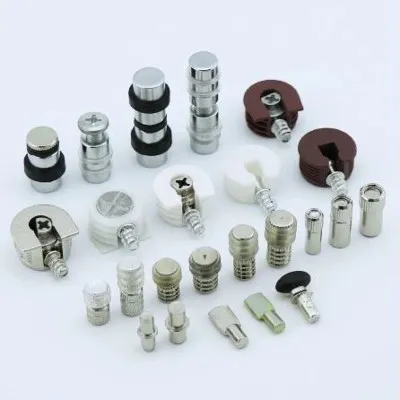

The connection of panel furniture requires connectors, and modern panel furniture connectors generally refer to eccentric connectors
Generally, it refers to the parts that play a role of fastening and connecting between the boards in the process of furniture production, that is, the furniture connectors, which mainly refer to: eccentric connectors, screws, rivets, nuts and bolts, etc., which is also At present, the general concept of furniture hardware industry, and the most used furniture connectors are eccentric connectors. Therefore, furniture connectors in the modern furniture industry generally refer to eccentric connectors.
There are many kinds of hardware parts of furniture, and its structure is required to be firm and reliable, and it can be disassembled many times, mainly to meet the functional requirements. The furniture hardware is divided into nine categories: the hardware commonly used in panel furniture mainly includes the following nine categories:

1. Lock interlocking In multi-drawer cabinets, an interlocking system is often used, also known as a central locking system. The utility model utilizes a plurality of braking pins on the guide rail to lock the drawers respectively, and only uses one lock head to lock multiple drawers at a time. The interlock has two installation forms, namely: (1) The lock head is on the front of the drawer, and the guide rail is installed on the side plate; (2) The lock head and the guide rail are installed on the side plate at the same time.
2. Connector:
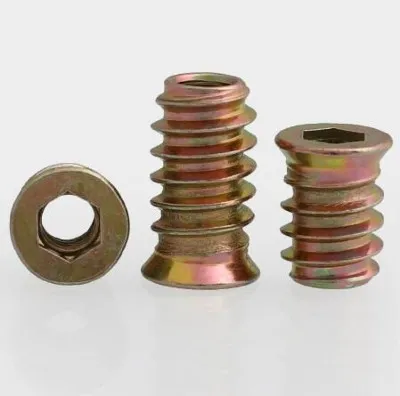
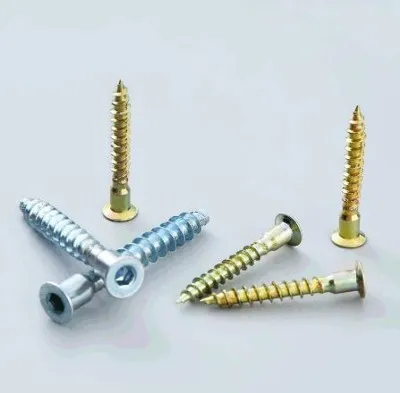
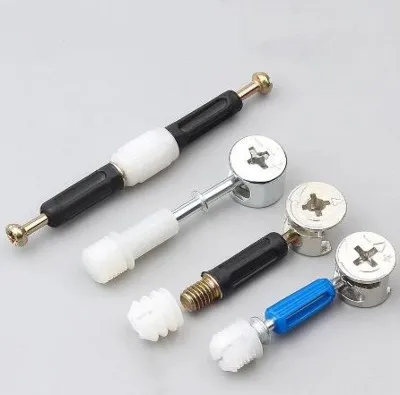
There are many varieties of connectors, typical varieties are eccentric connectors, screw connectors, plug-in connectors, etc. Eccentric connectors are more commonly used. They are suitable for industrialization, high-efficiency production, firm joints, and can be freely and quickly disassembled and assembled by themselves, without affecting the original appearance. It is mainly suitable for panel furniture. The eccentric connector is mainly composed of eccentric tensioner (eccentric), connecting rod (bolt) and embedded parts (expansion bolt). There are straight connecting rods and angle connecting rods.
3. Hinges: There are many kinds of hinges, such as hinges, door hinges, glass door hinges, cup-shaped hidden hinges, special special hinges, etc., which are used to connect two solids and allow rotation between them. . Hinges are constructed of movable components, or of foldable materials. The hinge is divided into full cover and half cover. The inlay is determined according to the side panel of the cabinet, and the thickness of the side panel is generally 16-18MM. The concealed hinge is divided into two parts: the base and the buckle. According to the bending arc of the buckle, it is divided into three types: straight arm concealed hinge, small curved arm concealed hinge and large curved arm concealed hinge. Door.
4. Slide rails: The most commonly used slide rails in furniture are drawer rails, and door slides. In addition, there are TV cabinets, disc rotating devices for dining table tops, ring bottoms for rolling shutter doors, and the combination of hinges and slides. device etc.
5. Position holding device
6. Height adjustment device
7. Supports: Supports are mainly used to support furniture components, such as shelf brackets, shelf supports, glass shelf pins, clothes stick seats, etc.
8. Handles: Handles play an important decorative role in furniture, with a wide variety of forms and varieties. According to different materials, there are metal handles (zinc alloy handles, copper handles, iron handles, aluminum handles, stainless steel handles), marble handles, plastic handles, solid wood handles, ceramic handles, etc.; according to different installation positions, there are drawer handles, cabinet door handles , glass door handle, etc.
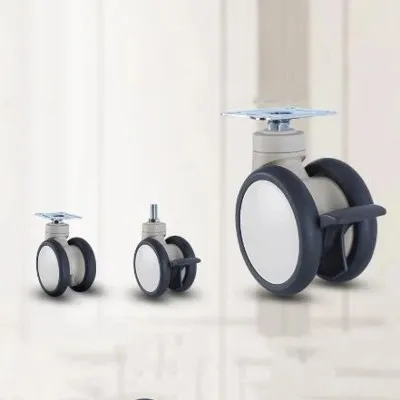
9. Casters: Casters are often installed at the bottom of cabinets and tables to move furniture. According to different connection methods, it can be divided into flat seat type, screw type and plug type.