

Why Choose Us
Immense experience
Founded in 2006, As an integrated technology corporation whose business covers a coordinated process of design,production and sale, and open mould for new items according to samples or drawings.
Quality safety
Strictly qualified and testing like hardness and calliper before shipping out, ensure customer's quality and delivery time.
Good services&Customized
Devoted to providing better services,lower cost. Welcome customized, accept open mould for new items according to samples or drawings.
Global layout
The product sales footprint covers more than 40 countries on four continents in asia, europe, america and africa.
Applications Of Casters
Manufacturing and Warehousing: In the world of manufacturing and warehousing, caster wheels are indispensable. They are heavily relied upon for moving heavy machinery, raw materials, and finished products with ease. Heavy duty wheels play a crucial role in these sectors, allowing for the smooth transportation of large and heavy items within the facility. This not only enhances efficiency but also helps in optimizing space management and workflow within these environments.
Healthcare and Laboratories: The healthcare sector benefits immensely from the precision and reliability of castors. In hospitals and laboratories, the need for transporting sensitive equipment and patient beds necessitates the use of swivel wheels for their smooth and quiet operation. These wheels are designed to offer stability and ease of movement in sensitive environments, ensuring that both patients and healthcare professionals experience minimal disruption.
Retail and Supermarkets: To improve customer experience and operational efficiency, retail spaces-especially supermarkets-use caster wheels. These wheels are added to stocking trolleys and shopping carts to make navigating aisles easier. Furthermore, these wheels are essential for securely and swiftly moving big loads of goods in stock rooms, which greatly improves the efficiency of the process of replenishing shelves.
Event Management and Staging: Because these fields are dynamic, they require flexible and reliable mobility solutions. This is where caster wheels come into play, giving sound, lighting, and stage equipment the movement they need. They are perfect for smooth and efficient setup and breakdown during events because of their capacity to support large weights and provide ease of mobility.
Manufacturing Process of Caster

Metal Plate Cutting Process
The first plate to be cut is the top plate. This is the plate used to mount the caster underneath the object, for example the industrial cart. The process begins with a thick sheet of steel that is cut by a CNC (computer guided machine that combines oxygen and electricity to produce plasma). Plasma cutting is a type of thermal cutting that uses an ionized gas to cut the metal. This means that the process uses heat to melt the metal rather than mechanically cutting it. It's one of the most common methods for cutting thick metal plates, but it's also useful for sheet metal. This method is very accurate and fast when cutting steel sheets.
The next part to be cut is the fork. Forks are the arms that hold each side of the wheel axle. The forks are made out of steel coil, a more flexible and thinner type of steel. The steel coil is rolled out and fed into a punch press machine which breaks it with the yoke shaped dye. The broken yoke shaped pieces are placed onto a forming press. The press bends the piece into the required shape and it also makes a circular groove around the hole in the middle. The hole is filled with steel ball bearings that allow the yoke to swivel. A steel retainer is fitted to hold the ball bearings in place. The grooves of the steel cap are filled with ball bearings as well then they place it onto a punch press and position the yoke on top. The press joins the cap to the yoke's retainer, sandwiching the ball bearings in between. After riveting the top plate to the yoke, put a steel seal over the retainer and lock it in place with a pneumatic press.
Rubber or Nylon Extrusion
The next machining process on the production of caster wheels is the extrusion of the wheel material. To make the wheels, nylon inserts are required. The inserts are placed in an injection molding press, which melt neoprene rubber and injects it into the mold. Once it cools to a solid state, the machine ejects rubber edged wheels. The rubber edge absorbs shock, reduces noise, and prevents damage to the floor or surface.
For bigger sized wheels, a different molding press is used to suit the required size. The molding process to produce the wheel is the same. These larger molding press machines usually make one wheel at a time. After the wheel is ejected from the molding press it is placed on a cool down rack for 2 and a half hours. The wheel mold is made up of two parts, which form a sim once attached. The rubber sim is then grinded down until the surface is smooth.
Assembly of Parts
A two part bearing is placed inside the wheel, and locked into position with a pneumatic press. A steel guide is then installed on either side of the wheel. The steel guides prevent anything from entering the wheel and inhibit its movement. The steel guides position the wheel between the yokes and insert the steel wheel axle. A bolt head secures one end and a nut is attached to the other end. Grease is injected to lubricate the ball bearings.
The wheel must undergo a series of quality control tests that count the number of revolutions a caster can withstand before it finally breaks.
Types of Casters
Plate Casters
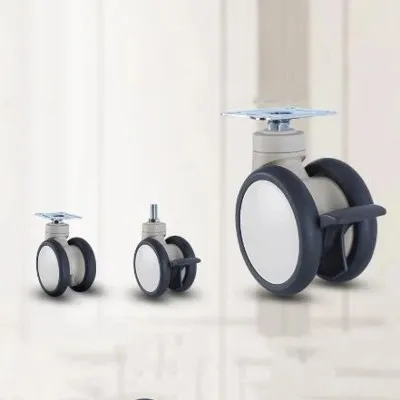
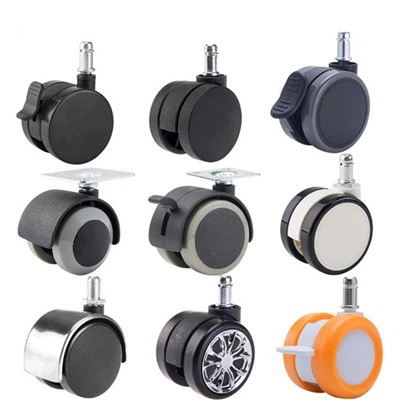
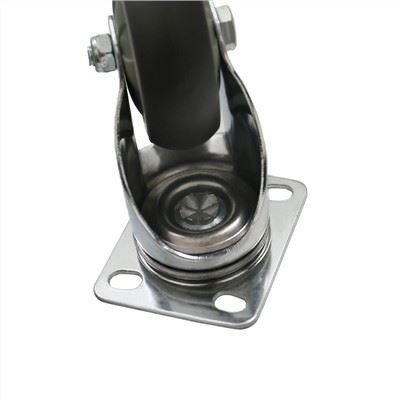
The most common type, plate casters are characterized by a flat, square-shaped mounting surface. They usually have four holes - one on each corner of the mounting surface - which are used to secure the plate caster to the object. They are called "plate casters" because the mounting surface resembles as a square-squared plate.
Locking Casters
As the name suggests, locking casters feature a locking mechanism. Conventional casters are designed to roll and swivel freely. While perfectly fine for some applications, other applications require casters to remain locked in place. If a workbench with casters is placed on a sloped surface, for example, it may roll downhill unless the casters are locked. Locking casters offer the freedom to lock the wheels in place, thereby preventing the object on which they are mounted from rolling or swiveling.
Stem Casters
Stem casters also feature a wheel in a mounting frame, but they are unique because of the way in which they are mounted. While plate casters have flat, square-shaped mounting surface, stem casters feature a cylindrical-shaped rod for mounting. In the image displayed above, the caster in the middle is a stem caster. The cylindrical-shaped rod is placed inside an object's mounting slot of the same shape and size. Some stem casters feature a threaded rod, whereas others feature plain round rods. Regardless, they all use rods for mounting.
Hollow Kingpin Casters
Hollow Kingpin casters are characterized by a stemless design with a hole on the top of the mounting surface. To mount a hollow Kingpin caster, the caster is positioned against the object, after which a fastener like a screw or bolt is driven through the hole and into the object.
Rigid Casters
Also known as fixed casters, rigid casters are characterized by their limited range of movement. Unlike other casters, rigid casters can't swivel in a complete 360-degree range. Rather, they can only roll forwards and backwards. Rigid casters are usually stronger than conventional casters, but their limited range of movement makes them a poor choice for certain applications.
What to Consider When Choosing a Caster
Wheel Diameter: Since larger wheels will roll more easily, you will want a wheel as large as possible, but you do not want a wheel that is so large that it will raise the center of gravity of your load that can lead to tipping.
Swivel Radius: If you are choosing a fixed caster this is not a concern, but if you need your caster to swivel you need to know how much clearance is required to attain a 360-degree swivel with the mounted caster.
Dynamic Load & Load Capacity: Each caster is designed and built to support a certain maximum load while in use, and exceeding this maximum can cause damage and deterioration of the caster, which can potentially lead to catastrophic failure. For this reason it is important to know the maximum load you will have so that you can divide this evenly among the casters you will use; more casters can mean more load capacity for a cart or trolley.
Rollability: Choosing the right bearing is critical in determining how well your caster will roll in application. To reduce the effort to initiate and sustain rolling, a good precision ball bearing is a wise investment.
Brakes: There are many braking options if needed, and each has pros and cons. Side and friction brakes are very economical while tread locks and top locks offer a more positive locking wheel. There is also the consideration of locking the swivel if this is needed for the job.
Mounting Considerations: Options include top plates, which are bolted into place and screw threads, or press threads that are inserted into a hole in your cart or trolley are also available.
Common mistakes to avoid when choosing casters
Neglecting Load Capacity Requirements: Factor in the loads you'll require the casters to handle so they can get the job done safely and effectively. You may especially wish to take this into consideration when selecting industrial casters.
Ignoring Environmental Factors: High heat, exposure to chemicals, and other environmental contributors can make unsuitable casters fail fast. Choose swivel casters that are made for the environment you'll be using them in.
Opting For The Cheapest Option Without Considering Long-term Costs: Price is always a consideration, and there are two ways to think about that. One is that you can pay as little as possible and try to get a moderate quality caster. What comes with that decision is potential failure at a critical moment, which could cause injury to a person and risk the breakage of the goods or equipment being transported. The other choice is to go with a quality rolling caster that's well-suited to the job you need it to do (high heat, uneven ground, supporting heavy weight). Then you have the best chance of the caster holding up under stress, reducing the potential for injuries, and providing better protection for the goods you are moving. Top quality casters can also save time by helping you get the job done with smoother operation.
Failing To Properly Install Or Maintain Casters: Setting up and maintaining casters helps keep them operating as they should. It's important to take care of this equipment so it can serve you as you require for a long time.
Caster Materials
Fiberglass wheels are ideal for heavy-duty, high-temperature environments.
Neoprene rubber wheels are highly resistant to grease, fats, and oils. They have a sufficient level of cushioning to protect floors and roll quietly, making them ideal for softer floor types.
Nylon wheels are ideal for heavy-duty, high-temperature, and corrosive environments. Suitable for both hard and soft floor surfaces, nylon wheels are great for concrete floors because of their durability and impact resistance.
Phenolic resin wheels are highly resistant to oil, grease, gasoline, and mild acids. They are ideal for use on smooth concrete floors and are not recommended for wet applications or rough surfaces.
Polyolefin wheels resist hard impacts and are non-marking. They are suited for use in wet and corrosive applications.
Polypropylene wheels provide easy rolling and chemical resistance. They work well in wet and oily environments.
Polyurethane wheels have some cushioning to protect floors and roll easily while handling a greater load capacity. Suitable for both hard, soft, and uneven floor surfaces, they are abrasion-resistant as well as resistant to grease and oils.
Solid rubber wheels are long-lasting because they do not have air inside, so you do not have to worry about flats. They provide good floor protection and a quiet operation, making them a great choice for softer floor types.
Stainless steel wheels feature a strong, durable design. They are rust- and corrosion-resistant, making them a sanitary option for wet environments.
5 Tips on How to Maintain Casters
#1) Clean the Floor
Don't forget to clean the floor on which you use the casters. Casters will inevitably pick up dirt and debris from the floor. As you roll them across the floor, your casters may become dirty. Cleaning the floor will reduce the amount of debris and debris that they pick up from the floor. Whether you use them in a factory, a warehouse or other environment, you should clean the floor to prolong the life of your casters.
#2) Tighten Fasteners
Tightening the fasteners on your casters can make them last longer. While there are several different types of casters, most of them are constructed with fasteners. Over time, these fasteners may become loose, which can cause the wheels to wobble. Fortunately, you can tighten the fasteners to prevent this from happening. Using a screwdriver or socket wrench, tighten all of the accessible fasteners on your casters.
#3) Dislodge Debris
Another maintenance tip is to dislodge debris from your casters. As previously mentioned, casters will pick up debris from the floor. Cleaning the floor on a regular basis can help to reduce the amount of debris that they pick up. Nonetheless, you'll still need to clean your casters. You can dislodge dirt, dust and other debris that's stuck inside your casters by spraying with canned air. A few blasts of canned air should dislodge most debris while leaving your casters cleaning and better protected from damage.
#4) Lubricate
Casters require lubrication to roll smoothly. While they are usually lubricated when initially manufactured, it won't last forever. Lubrication will dry out and evaporate. For longer-lasting casters, you'll need to reapply lubrication. You can spray a lubricant around the wheels of your casters to keep them rolling smoothly.
#5) Inspect Swivel Joint
If you have swivel casters, you should inspect the swivel joint to ensure it works as intended. Swivel casters are those that are capable of swiveling in a full 360 degrees. They feature a swivel joint to which the wheels are attached. If the swivel joint is damaged or degraded, though, they won't be able to perform this swiveling action. To maintain your swivel casters, you should inspect the swivel joint for signs of premature wear and tear.
FAQ
Q: What is the role of caster?
A: Caster is a job that involves pouring molten metal into moulds to create products or components from the metal. It requires a skilled operator to ensure that the molten metal is poured accurately and safely.
Q: What are casters used for?
A: A caster is an assembly that includes a wheel and a mount. Casters support and make it easy to maneuver carts, racks, dollies and other equipment. Casters come in different materials, wheel diameters, tread widths, load ratings and overall heights to give your equipment mobility in many kinds of work environment.
Q: How does caster work?
A: Caster causes a wheel to align with the direction of travel, and can be accomplished either by caster displacement or caster angle. Caster displacement moves the steering axis ahead of the axis of wheel rotation, as with the front wheels of a shopping cart. Caster angle moves the steering axis from vertical.
Q: What material is caster?
A: These wheels are made of precision molded polyurethane mechanically bonded to a polyolefin core. These wheels offer easy roll-ability, floor protection, non-marking and non-conductive performance. Polyurethane resists most chemicals, oils and rejects floor debris.
Q: What are the parts of a caster?
A: When you need wheels or casters, either as replacements for your worn-out casters or for a piece of equipment that doesn't already have wheels, it's good to know the terminology. This is a quick primer. Casters have three basic parts: top plate, fork, and wheel.
Q: What is the manufacturing process of caster?
A: Liquid steel is brought to the continuous caster in a ladle. In the caster, the still liquid steel passes through a mould and then through a sequence of 'segments', during which its vertical path out of the ladle and the mould gradually becomes horizontal, as it cools.
Q: Are castors removable?
A: For threaded casters, twist them clockwise until they loosen and can be removed. For grip stem casters, lubricate the joint between the caster and the frame, then pull the caster away from the socket.
Q: How do I keep my caster wheels from rolling?
A: If your casters don't have built-in brakes, you can use wheel chocks or wedges under the wheels to stop them from moving. Another option is to replace the current casters with locking casters, which is a more permanent solution. Whichever method you choose, make sure it's safe and doesn't damage the wheels or flooring.
Q: Do bigger casters roll better?
A: Casters with a big wheel are easier to roll than those with a small wheel. They require less force to roll, making them preferable in workplaces and other spaces with uneven floors. If you're planning to use them on uneven floors, you may want to choose casters with a big wheel.
Q: How do I stop my caster wheels from shaking?
A: Increasing swivel lead– A longer swivel lead reduces the forces that push the caster sideways. It also increases the caster's natural frequency. This helps keep the caster from fluttering at low speeds.
Q: How to grease caster wheels?
A: Lubricate: Spray lubricant onto every moving part of the caster. Brush: Use a toothbrush or toothpick to reach the nooks and crannies. Wipe: Wipe away any excess lubricant with a separate clean, soft cloth.
Q: What can cause bad caster?
A: High speeds can cause many issues with casters that weren't designed for that specific application. Catastrophic failures can occur due to caster overheating, damage to the caster wheel hub, or damage to the bearings.
Q: How do you make casters roll smoothly?
A: Lubricate your casters and wheels often Adequate lubrication helps keep casters rolling smoothly. Lubricate all caster wheels and fittings every six months to keep them working properly.
Q: How long do castor wheels last?
A: These casters last many years without replacement if they are properly cared for. This is the key, proper care and preventive maintenance will greatly prolong caster life, while misuse and mistreatment can lead to premature failure.
Q: How to keep caster wheels clean?
A: If you're sure your wheels don't need a deep clean, you can wipe them down with a damp cloth. Make sure to wipe the inside and outside of the wheel cover. Use cotton swabs to reach places that are hard to get to. If you think your wheels need a thorough cleaning, soak them in warm, soapy water for 5 to 10 minutes.