

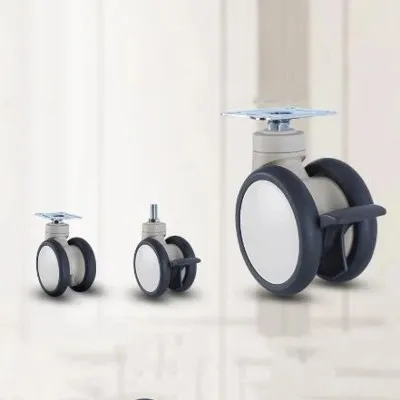

Among hardware accessories, casters may seem inconspicuous, but they directly affect the mobility and user experience of furniture and equipment. One of the most important selection dimensions is the material of the wheel. Casters of different materials not only have different load-bearing capacity and rolling smoothness, but also have different effects on the ground, and even affect the overall noise and durability.
For furniture manufacturers, commercial equipment providers or project purchasers, understanding the differences in caster materials is the first step in making a suitable selection.
Nylon casters: high strength, smooth sliding, suitable for hard floors
Nylon casters (PA material) are known for their high strength and strong wear resistance, and are the most common wheel material in the industrial and commercial fields. They roll smoothly and are not easy to deform, and can perform well on hard floors such as cement floors, tiles, and metal floors.
Applicable to: file cabinets, display racks, industrial carts, etc.
Advantages: low rolling resistance, long wear life, high cost performance
Reminder for use: not recommended for easily scratched floors, such as solid wood floors
Polyurethane (PU) casters: quiet sliding, a good choice for protecting floors
Polyurethane casters are currently the preferred material for high-end furniture and light industrial equipment. It takes into account both softness and wear resistance. It is silent and smooth when rolling and will not scratch the floor. It is especially suitable for places with high requirements for appearance protection, such as wooden floors and tiles.
Applicable to: high-end office cabinets, medical carts, display props, etc.
Advantages: silent, non-slip, not easy to slip, no damage to the floor
Applicable floors: wooden floors, tiles, epoxy resin floors
Rubber casters: shock-absorbing and silent, suitable for occasions with high buffering requirements
Rubber wheels are very popular in use scenarios that require frequent pushing or avoiding vibrations due to their good elasticity and shock absorption. The friction is slightly larger during rolling, but the buffering effect is obvious, especially suitable for quiet environments and uneven floors.
Applicable to: hospitals, libraries, studios, baby equipment, etc.
Advantages: soft and shock-absorbing, sound-absorbing and quiet, strong grip
Usage suggestions: pay attention to the large temperature difference in the environment may affect the elasticity of the rubber
Metal casters: extremely durable, the best choice for high-intensity scenes
Stainless steel or aluminum alloy casters are mainly used in industrial or special occasions with high requirements for load-bearing and corrosion resistance. Compared with other materials, metal wheels are more resistant to high temperatures, oil stains, and rust. At the same time, they have a tough appearance and are also suitable for certain styles of furniture design, such as industrial style and metal texture furniture.
Applicable to: heavy equipment carts, factory workshops, high-end metal furniture
Advantages: stable structure, rust-proof and wear-resistant, long service life
Usage reminder: rolling may produce loud noise, it is recommended to use a buffer bracket