

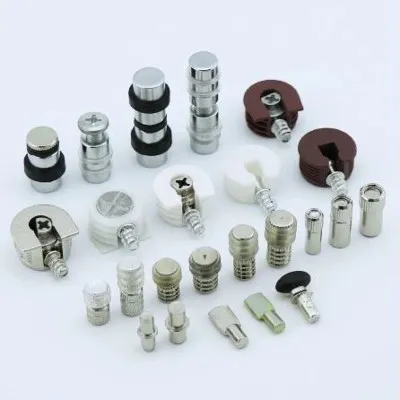
Bolt types belong to the threaded fastener family and are used in combination with threaded nuts, usually to join two or more components. Bolts are divided into different types based on their head shape, strength, surface finish and material.

Bolt types and their uses. All these classifications play an important role in the final selection of the type of bolt for a specific application. You must have the knowledge to choose the correct bolt type for the specific job at hand, as there are several types of bolts that are more effective than others.


Bolt head shape types
Bolts and screws have a wide variety of head shapes. These heads are used to hold tools for tightening bolts.
The most common bolt head types include square, hexagonal and slotted hex washers and caps.
The first bolt heads used were square heads. The square head consists of a square groove in the head and a shaft that prevents rotation when torque is applied. Square heads are still used today, but hex heads have become more common. Hex heads are used with wrenches or wrenches to provide torque.
There are many other head shapes in use namely flat head, oval head, flat head, round head, button head and truss head.
Bolt strength type
Regarding the materials used to make the bolts and the dimensions to which the bolts are made.
The following table lists several typical materials of common bolts and their corresponding markings. The materials listed in the table are in ascending order.
- Low-carbon steel
- Carbon steel
- alloy steel
- Stainless steel
Bolt Surface Finish Type
Bolt surface coating refers to the coating used on the bolt material. Depending on the type of application required, surface coatings can range from extremely high to minimal quality.
Anti-corrosion finishes are common examples of extremely high-quality finishes, while decorative finishes used to color bolts are classified as lower-quality finishes. At least some of the bolts may not be coated.
There are many types of bolt surface treatments currently used, and they are mainly classified as follows:
Common bolt types
Uncoated. Also known as natural color, natural color, black. If no surface treatment is specified, the bolt will automatically be interpreted as uncoated. Regular facing bolts are not corrosion resistant.
Galvanized bolt types
The thicker the coating, the greater the corrosion resistance and vice versa. It is widely used due to its low price. The coating is smooth and the screw surface has a good finish. These coatings are also easy to work with and provide a paintable surface if desired.
Yellow plated bolt type
Zinc Chrome Yellow is also known as Zinc Yellow, z/chr or Zinc Chrome Yellow. This mixture is heavier than clear chromate and therefore has better corrosion resistance.
Hot dip galvanizing (HDG)
A process in which bolts are immersed in molten zinc. Zinc adheres to fasteners when immersed in water. Since the bolts are immersed in water, the coating thickness is much greater than galvanizing. Therefore, it has excellent corrosion resistance.
Bolt type material
It is important to select the appropriate fastening material for a specific application. This is because bolts are used in a variety of heavy-duty and light-duty applications, and the material of these bolts must be chosen accordingly.
Using steel bolts instead of aluminum bolts can greatly affect the quality and durability of the resulting joint. Other factors, such as environmental conditions, the presence of corrosive components, and structural stability, may alter the effectiveness of the material.
Some common bolt materials include:
steel
It is the most commonly used material due to its high formability, tensile strength and durability. Steel is cheap to manufacture and widely available.
A variety of alloys are available to provide varying degrees of strength to suit different applications.
Stainless steel
An alloy that combines the properties of mild steel with specific levels of chromium and nickel. The chromium in stainless steel makes it corrosive.
Low carbon content prevents hardening. Stainless steel can be martensite or austenitic. Martensitic stainless steel is durable and can be strengthened by heat, but has poor corrosion resistance.
Austenitic stainless steel is the most common type of stainless steel and contains high levels of nickel and chromium, giving it excellent corrosion resistance.
This stainless steel can also withstand considerable loads without cracking.