

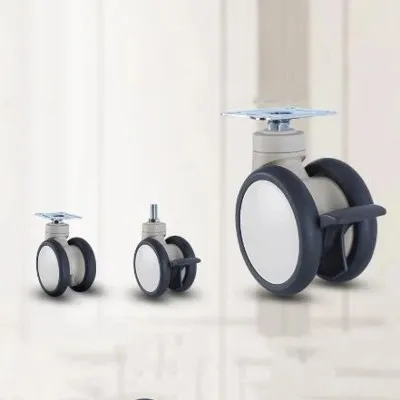
Industrial caster wheel is a type of wheel specifically designed for heavy-duty industrial applications. Caster wheels are mounted to the bottom of equipment, carts, or other objects to enable easy movement and transportation. Industrial caster wheels are built to withstand the demands of industrial environments, including rough surfaces, heavy loads, and frequent use.These caster wheels are typically made from durable materials such as steel, cast iron, or high-strength plastics to provide strength and stability. They often have features like swivel mounts to allow for easy maneuverability and locking mechanisms to keep equipment in place when needed. Industrial caster wheels come in various sizes, load capacities, and designs to suit different industrial needs, such as in warehouses, factories, distribution centers, and other industrial settings where heavy objects need to be moved efficiently and safely.
Advantages of Industrial Casters
Enhanced Mobility And Flexibility
The primary advantage of industrial caster wheels is their ability to significantly improve the mobility of heavy machinery and equipment. Especially with industrial swivel wheels, the ease of maneuvering in tight spaces becomes a less daunting task. This enhanced mobility is not just about moving things around; it's about doing so efficiently and effectively, reducing time and effort in industrial operations.
Increased Load Capacity And Durability
Industrial heavy duty wheels are specifically designed to bear substantial weights, a critical feature in industrial settings where heavy loads are the norm. These wheels are not just about holding weight; they are about enduring it over time. The durability of these wheels ensures they can withstand continuous use, often in challenging conditions, without compromising performance.
Safety Features And Ergonomics
In any industrial setting, safety is of utmost importance. Industrial castors play a major role in this regard. Ergonomic elements are incorporated into many caster wheels to lower the possibility of damage when moving large objects. This includes designs that minimise user strain by requiring less physical effort to manoeuvre and provide greater control and stability.
Versatility In A Range Of Industries
The adaptability of industrial caster wheels is one of their main advantages and uses. Numerous industries, including industrial, automotive, healthcare, and retail, employ these wheels. The unique qualities of caster wheels, such as their capacity to support large weights, move precisely, and adjust to various floor surfaces, are advantageous to all industries.
why choose us
Immense experience
Founded in 2006, As an integrated technology corporation whose business covers a coordinated process of design,production and sale, and open mould for new items according to samples or drawings.
Quality safety
Strictly qualified and testing like hardness and calliper before shipping out, ensure customer's quality and delivery time.
Good services&Customized
Devoted to providing better services,lower cost. Welcome customized, accept open mould for new items according to samples or drawings.
Global layout
The product sales footprint covers more than 40 countries on four continents in asia, europe, america and africa.
Business Uses of Industrial Casters
Warehouses & Distribution Centers
While these casters are not as flashy as some other chair and furniture casters that are only used in an office setting, they are stylish in their own way and are resistant to the warehouse environment in which they operate. Temperature extremes, high speeds, aggressive chemicals, and uneven outdoor terrain are just a few of these harsh environments industrial casters can withstand.
Industrial casters are ideal for warehouses and distribution centers. Medium-duty industrial wheels and casters can be used to move over 500-1,500 pounds of material across large warehouse floors or outside surfaces like docks. Industrial casters can also handle the weight of shelving, carts, and more while moving heavy objects.
Manufacturing
Industrial casters are not just for warehouses or distribution centers. These types of casters also have a variety of uses in the manufacturing environment. Whether they're used to move things around on an assembly line or during production processes, industrial casters are often found in industrial manufacturing facilities.
Due to their durability and strength, industrial casters are a great choice in production settings. For example, heavy-duty caster wheels are used to move large workpieces, assemblies, and equipment in the aerospace and aircraft manufacturing processes.
Industrial casters are also an integral component of material handling equipment and storage systems. This is a simple task in an industrial setting, where the caster wheels can be attached directly to the machinery, making industrial casters an integral part of the manufacturing process.
Hospitality
The hospitality industry uses industrial casters as a way to make moving equipment around the property easier. It is crucial to have casters in place when equipment is used in a restaurant or hotel. Industrial casters help make it easier for workers and customers, preventing injuries and making sure that items and equipment are easy to move.
These casters provide safe, easy mobility, which can be used in a variety of applications such as:
Banquet tables at hotels and restaurants
Cafeteria carts and serving stands
Laundry carts or dollies at resorts and laundromats
Kitchen equipment such as industrial ovens, refrigerators, and dishwashers
Hotel and motel beds
Types of Industrial Casters


Plate Casters: These are the most basic type of industrial caster, and consist of a wheel that is mounted to a metal plate. The plate is then attached to the bottom of the equipment or machinery using bolts or screws. Plate casters are available in a wide range of sizes and capacities, and can be made from a variety of materials, including steel, aluminum, and plastic.
Stem Casters: These are similar to plate casters, but instead of a plate, the wheel is mounted to a stem or pipe that is inserted into a socket or mounting plate. Stem casters are available in a wide range of sizes and capacities, and can be made from a variety of materials, including steel, aluminum, and plastic.
Rigid Casters: These are similar to stem casters, but do not have the ability to swivel. They are designed to be used on equipment that needs to be moved in a straight line.
Swivel Casters: These are similar to plate casters, but the wheel is mounted to a swivel raceway that allows the wheel to rotate 360 degrees. This allows the equipment to be easily moved in any direction.
Pneumatic Casters: These casters have an inflatable tire made of rubber or other materials, Pneumatic casters are designed for use in rough or uneven terrain.
Phenolic Casters: These casters have a wheel made from a composite material known as phenolic. Phenolic casters are resistant to high temperatures, chemicals and are lightweight.
Choosing the Right Caster for Your Industrial Needs
Assess the Environment: The floor condition, presence of chemicals, temperature, and the type of debris in the area can all influence the choice of caster. For instance, industrial metal caster wheels might be perfect for high-temperature areas.
Consider Load Capacity: Ensure the casters can handle the maximum load plus an additional safety margin. This is where knowledge about Industrial Caster Wheels all you Need to Know becomes invaluable.
Wheel Material: The type of material can affect the performance and longevity of the caster. Rubber wheels might offer cushioning, while polyurethane wheels could provide a blend of strength and floor protection.
Fixed or Swivel: Decide whether you need the straightforward path of fixed casters or the maneuverability that swivel industrial caster wheels offer.
Braking Mechanism: If the application involves slopes or requires the loads to be held stationary, choosing industrial caster wheels with brakes is a must.
Floor Protection: Consider softer wheel materials if protecting your flooring is a priority, to prevent scratches and wear.
Ergonomics: The easier a caster is to move, the less strain on the operator, which is critical in preventing workplace injuries.
Regulatory Compliance: Ensure the casters meet all required industry standards and regulations.
Reasons Industrial Casters Fail and How to Avoid Them
Caster Capacity Overload
The main reason that casters fail in the field is the load capacity applied to the caster exceeds its rated capacity. To avoid this pitfall, consider the heaviest load that will be used in the application. Due to situations arising from uneven floors or bumps etc. it is possible that a four wheeled cart may have only three wheels actually absorbing the full load. A safety factor based on the use of three casters is therefore used to address this which means that if the load capacity is 2,000 lbs., a caster with a load rating of at least 667 lbs. is recommended.
Impact Loading
Impact loading occurs when a caster hits a large obstacle or bump and experiences the resulting g-forces. This means that if a caster with a load capacity of 100 lbs. hits a bump and experiences 5 g, it's as if the caster is carrying 500 lbs. at that moment.
This impact load can cause a catastrophic failure of the caster due to the peak g-forces which cause the caster to bear a higher load than its rated load capacity.
Brinelling
Brinelling is the dent or "wear" that is pressed into a hard surface. Brinelling occurs in a caster when the ball bearings in the swivel head begin to develop grooves in the hard cap. Brinelling affects the performance of the swivel of the caster by increasing the swivel force. Swivelling forces are typically the largest mobility force that a material handling cart will experience.
Excess Swivel Offset
Excess swivel offset in a caster is generally due to a design flaw. It refers to the distance between the center of the axle and the center of the king pin or main rivet being too great. Having an excessive swivel offset creates a situation that when a load is applied, the legs of the yoke may break away from the swivel. There is a fine balance between a large enough offset that ensures ergonomic efficiency while short enough to ensure joint strength is not compromised. Working with a competent design and engineering team can assist in ensuring optimal offset is achieved.
Wrong Bearing Type
Bearings are the part of the caster that limits movement to preferred motion and reduces friction between the moving parts within the caster. Using the wrong bearing type for a specific application can also be a cause of failure. For example, an application experiencing high side thrust. A tapered bearing would best be utilized. Improper bearing selection will cause premature failure of the caster. Various considerations should be made such as; bearing material, race construction and accessibility for maintenance if required.
Environmental Conditions
Environmental conditions can cause a caster to fail. In wet environments, using casters that don't have stainless steel or chrome finishes, which are well-suited to these environments can lead to to corrosion. With corrosion comes the weakening of the caster components and increased risk of caster failure. Other environmental considerations include: surface characteristics (rough, uneven, slope etc.) and debris or other contaminants. Our Workplace Ergonomics Guide sheds light on more environmental conditions that could impact your choice of caster.
High Speeds
High speeds can cause many issues with casters that weren't designed for that specific application. Catastrophic failures can occur due to caster overheating, damage to the caster wheel hub, or damage to the bearings. Understanding the speed at which the caster will be used in its intended application will help you choose the right caster. For instance, you would need a much different caster for a manual material handling cart vs. a towable cart which can experience speeds in excess of 5 miles per hour.
Soft Top Plates
The function of the top plate of a caster is to provide secure attachment to the structure, protect the wheel and ensure the wheel direction is maintained. Having a thin top plate or one that isn't hardened steel can make it very easy for it to bend out of shape potentially compromising both the load capacity and the directional intent of the caster. This condition mainly occurs when a caster goes over an obstacle and is damaged by the resultant impact. More robust and hardened top plates eliminate this issue.
King Bolt/Rivet Failure
Many casters are designed with the use of a rivet or kingpin bolt. These components generally have much of the stress concentrated on them when a high load is applied. Because of this, they are prone to failure when used in the wrong application. The solution to this potential issue is to use a Kingpinless caster that distributes the stress over a larger area on the caster.
Extreme Temperatures
Extreme temperatures can greatly affect the mobility performance of a caster. Many caster wheels are made from a variety of polymers and rubbers, which tend to lose their material properties when introduced to extreme temperature changes. Choosing the right wheel material to correspond with the temperature of the operating environment is the key when deciding on the right caster to use.
Materials Used in Industrial Casters
Metal: With the highest capacity and tensile strength, these wheels are popular for high heat applications. For heavy applications metal wheels, including steel and cast iron, are one of the most popular options. They provide easy rolling, but do not offer floor protection on soft flooring. Load capacities can be very high with these wheels.
Rubber: Another very common material, these long wearing wheels are widely used on industrial equipment and can be molded onto iron, aluminum or plastic centres. This application is called Mold-on rubber and provides the soft tread of rubber with the hard backing of the wheel centre.
Polyurethane: Carrying higher loads than rubber, and also outlasting it, they offer protection for your floor and quiet operation. Polyurethane is liquid cast onto cast iron, aluminum or forged steel centres.
Nylon/Plastic: For easy rolling, chemical resistance and high capacity these casters can't be beat. The plastic composition allows these to be used where other wheel materials would be worn away by harsh chemicals. They include Nylon, Phenolic or Polyolefin materials and can have very high load capacities.
Pneumatic/Solid/Semi: These wheels work well on rough and uneven surfaces and provide the best cushioning in these terrains. Often offering larger wheel diameters for easier, rolling these are the preferred wheel type of outdoor applications on soft surfaces such as grass. They turn quietly and protect softer floors and outdoor surfaces.
How to Maintain Industrial Casters
Choose The Right Industrial Caster
The most important thing to ensure the high durability of casters is to choose the right ones for your specific work environment. For example, if you have to move material over uneven surfaces, but you picked casters that aren't able to absorb shock appropriately, it is very likely that your casters won't last long. There is a great number of different types of casters that it can be hard to know which ones to pick. To select the right caster wheels, it is important that you know your load weight. The higher the load weight is, the larger and denser the caster wheels should be. The floor conditions, environmental factors, and extreme temperatures should be considered as well if selecting new caster wheels.
Make Sure That Your Industrial Caster Wheels Are Properly Lubricated
One of the most important things to maintain industrial caster wheels is to lubricate them as needed. Always make sure that all casters spin at the same rate on each cart. Otherwise, stress may be put on only one caster wheel, which can influence its lifespan and can be an issue for safety. Caster wheels should be lubricated every six months. The best way to do it is to schedule a time to inspect and lubricate all casters at the same time. If casters are used very often in volatile environments and get wet a lot or are exposed to highly corrosive materials, they should get lubricated on a far more frequent basis.
Keep Floors Clean
Of course, it is very important to maintain caster wheels themselves, but the floors play a crucial factor as well when it comes to the life span of casters. The fewer obstacles and the less debris on the floor, the longer the industrial casters will last. When industrial casters are used in an environment with moisture, chemicals, heat, cold or other factors that could affect them, it is important to purchase the right casters in the first place.
Regularly Check The Fasteners That Hold The Industrial Casters In Place
To check the hardware fittings that make sure the wheels don't move is just as important as the caster's lubrication. At least once a month you should make sure that the wheels are in place and don't move around or even fall off completely. During these checkups, you should also look for bolts, screws or nuts, as well as any other defects that need to be fixed or replaced immediately.
Examine Industrial Caster Wheels
Usually, casters come with a small rubber fitting to insure smooth turns and little noise. These rubber fittings can get damaged or even flattened. A flattened wheel can place more wear and tear on the wheel itself, which can ruin the entire hardware of the industrial caster. If you examine defects, you should repair or replace the casters right away before it becomes a larger and more expensive problem.
Make Necessary Repairs Sooner Than Later
If an industrial caster wheel stops rolling smoothly or stops rolling completely, it is important to make repairs right away. One broken caster can affect the other casters on the cart or truck as well. To repair or replace a single caster costs less than having to repair or replace all of them.
FAQ
Q: What are industrial caster wheels and why are they important?
Q: How do I determine the right load capacity for my industrial caster wheels?
Q: Can industrial caster wheels be used on any type of flooring?
Q: What maintenance routines should I follow for my industrial caster wheels?
Q: Are there industrial caster wheels that come with brakes, and when should they be used?
Q: What is the load height of a caster?
Q: How do you measure caster?
Q: Why is caster important?
Q: What are the applications of caster wheel?
Q: How are casters made?