

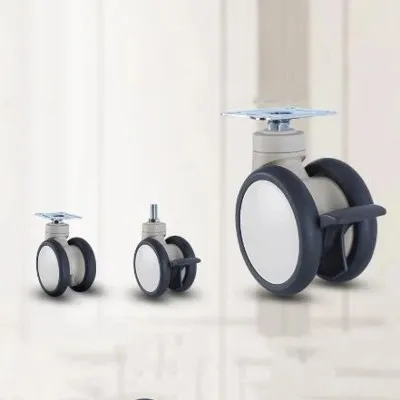

Due to the nature of the medical industry, casters for medical usage require special considerations. Exposure to fluids and chemicals often require frequent wash-downs, and quiet mobility provides recovering patients with one less distraction. Stainless Steel casters and Nylon-bodied casters are rust resistant and can withstand exposure to chemicals and washdowns. Precision bearings in both swivel raceways and wheels provide a smooth, quiet ride for both cart and patient. While they may be labeled "medical," these casters are also great for any environment where chemicals are possible, or when a quiet caster is preferred.
Advantages of Medical Casters
One Of The Most Important Benefits Of Medical Casters Is Their Ability To Improve Patient Care
With the use of medical casters, healthcare professionals can easily move patients to different areas of the facility for testing or treatment. They also allow for easier positioning of patients for surgery or other procedures.
Medical Casters Can Help To Increase Efficiency Within Healthcare Facilities
Since medical equipment and devices can be easily moved around with the use of casters, healthcare professionals can quickly respond to patient needs without having to waste time and energy manually moving equipment.
Another Benefit Of Medical Casters Is Their Ability To Improve Safety
Most medical casters are designed with locking mechanisms that prevent equipment and devices from rolling away or tipping over. This can help prevent accidents and injuries within healthcare facilities.
Withstands Extreme Temperatures
The environment in which the medical casters will be used is another benefit. Some casters are designed to withstand exposure to harsh chemicals or extreme temperatures, while others may not be suitable for use in these types of environments.
why choose us
Immense experience
Founded in 2006, As an integrated technology corporation whose business covers a coordinated process of design,production and sale, and open mould for new items according to samples or drawings.
Quality safety
Strictly qualified and testing like hardness and calliper before shipping out, ensure customer's quality and delivery time.
Good services&Customized
Devoted to providing better services,lower cost. Welcome customized, accept open mould for new items according to samples or drawings.
Global layout
The product sales footprint covers more than 40 countries on four continents in asia, europe, america and africa.
The casters for the hospital beds cart include two hubs, a tire arranged on the periphery of each hub, and a protective cover covering the outside of each hub. The two hubs are respectively arranged on both sides of the medical caster bracket. The medical caster bracket is equipped with a positioning device. The positioning device is designed, using the adjustment of the up and down swing angle of the adjusting piece, the adjusting piece swings upward so that the second positioning tooth moves upward, and under the action of the spring of the reset column, the teeth of the first positioning tooth and the inner side of the second positioning tooth The tooth grooves are engaged, to realize the adjustment and control of the rotation direction of the medical casters.
When the adjustment piece continues to swing downward, the second positioning tooth presses the brake connection part to move downward, and the downward movement of the brake connection part makes the arc-shaped rocker plate Under the principle of leverage, the other end is lifted, and the teeth on the brake stop at the other end mesh with the teeth on the inner wheel side of the hub, thereby realizing the brake on the medical caster.
Key Factors To Consider When Choosing Medical Casters


Load Capacity
The load capacity of medical casters is a critical factor to consider. Different healthcare equipment has varying weight requirements. Be sure to choose casters that can support the weight of the equipment any additional load it may carry to ensure stability and safety during transportation.
Durability And Material
Healthcare environments demand durable casters that are capable of withstanding constant use, cleaning, and disinfection. Stainless steel or high-quality plastics are common materials used for medical casters. Ensure the casters are resistant to corrosion and chemicals commonly found in healthcare settings.
Flooring Type
Hospital environments often have diverse flooring types, including tile, carpet, and linoleum. Consider the type of flooring in your facility when selecting casters. Different casters are designed for specific surfaces, ensuring optimal mobility and minimizing wear and tear.
Size And Diameter
The size and diameter of medical casters play a vital role in their maneuverability. Smaller casters offer more precision in tight spaces, while larger ones provide better stability and weight distribution. Make sure to carefully assess the equipment's usage and the available space to determine the appropriate caster size.
Swivel And Locking Mechanisms
Medical casters come with various swivel and locking mechanisms. Swivel casters allow for easy maneuvering, while locking mechanisms provide stability when needed. Consider the requirements of your healthcare equipment to determine the ideal combination of swivel and locking casters.
Noise Level
In quiet hospital environments, noise from equipment movement can be disruptive to patients and staff. Medical casters need to be smooth and quiet to ensure they do not detract from patients' experience in a hospital. Casters can be designed to minimize noise through specialized materials and construction. Considering your floor types can also help you find the right noise-reducing casters for a quieter healthcare environment.
Maintenance And Cleaning
Easy maintenance and cleaning of casters are crucial in hospitals, where bodily fluids, dirt, and other potential contaminants abound. Easy-to-clean casters can help with infection control and overall hygiene in healthcare settings. Choose casters that are simple to clean and maintain, with features that help prevent dirt accumulation, to reduce downtime for equipment.
Medical Casters Typically Consist of the Following Main Components
Wheels
Wheels are often made from various materials like rubber (TPR), polyurethane (PU), or metal, to provide sturdy support and smooth mobility.
Brackets
Brackets are the parts that connect the wheels to the equipment and are typically made of metal or plastic to ensure stability and reliability.
Bearings
Bearings allow the wheels to rotate smoothly, reducing initial push force and rolling resistance, thus enhancing maneuverability.
Types of Medical Casters
Fixed casters
Definition and Function: Fixed casters cannot rotate and are designed to provide stability and support. They are typically used for stationary medical equipment such as surgical tables and medical beds.
Typical applications: Fixed casters are commonly used in operating rooms and bedside care units to ensure the stability of equipment.
Swivel casters
Definition and Function: Swivel casters can rotate 360 degrees, providing greater maneuverability. They allow medical equipment to move in all directions, not just forward and backward, making them more versatile.
Typical applications: Hospital beds are often equipped with swivel casters, allowing healthcare professionals to easily change the bed's orientation to meet the needs of patients and doctors.
Directional casters
Definition and Function: Directional casters can only roll in a forward and backward direction, suitable for equipment that needs linear movement. They provide additional maneuverability while maintaining stability.
Typical applications: Some medical equipment requires movement in a limited space, where directional casters are highly useful.
Braked casters
Definition and Function: Casters with built-in braking mechanisms can be used to secure medical equipment to ensure safety. The brakes prevent the equipment from moving accidentally.
Typical applications: Operating rooms and bedside care units commonly use casters with brakes to meet both mobility and stability requirements.
Application of Medical Casters
Hospital Casters
In a hospital setting, patient comfort, equipment mobility, and hygiene maintenance are of paramount importance. Hospital casters come into play in areas like patient beds, allowing for easy movement and adjustment. They are also found in critical care units on life-supporting equipment and medical carts. These casters provide silent mobility, essential for a patient's recovery environment.
Medical Waste Casters
Medical waste management is a crucial aspect of any healthcare institution. Casters fitted on medical waste bins facilitate easy transport of waste materials, minimizing the risk of contamination. These casters are built to withstand harsh chemicals and frequent cleaning, ensuring longevity and optimal performance.
Laboratory Casters
Laboratories are environments of precision where even the slightest vibration can impact results. Casters used in labs must provide smooth and controlled mobility, a feature that's essential when transporting sensitive substances or delicate equipment.
Pharmaceutical Casters
Pharmaceutical facilities require stringent cleanliness standards, and the casters used in this setting must meet these requirements. Casters on pharmaceutical equipment must resist chemical reactions, endure regular sterilization, and allow for the smooth transport of medicines and other pharmaceutical products.
Cart Casters
Medical carts, carrying everything from emergency medical supplies to patient records, are the workhorses of any healthcare facility. The casters on these carts must offer easy maneuverability, especially in emergency situations. They should also minimize noise to ensure a peaceful environment for patients.
Business Machine Casters
Even in administrative areas of healthcare settings, the role of casters cannot be overlooked. Business machine casters attached to office equipment like printers or filing cabinets help in efficient space management and offer easy access to necessary documents and equipment.
The Application of TPE Material in the Production of Medical Casters
All kinds of casters in daily life, such as stroller casters, luggage casters, and industrial shelf casters, are generally made of rubber, foamed EVA, PU and other materials. These materials either have a strong smell or make rolling friction noise on the ground. TPE is gradually replacing natural and synthetic rubber because of its ability to form various shapes according to the requirements of many traditional or innovative processing technologies to meet the needs of complex modeling designs. TPE also has high heat resistance, chemical resistance, weather resistance and oxidation resistance, and is relatively widely used. Medical is an important application field of TPE. In the past few years, the demand for disposable syringes and medical catheters in the medical market has increased sharply, and TPE has gradually been used to make products such as casters.
At present, TPE is used in the medical industry such as breathing bags, breathing masks, medical catheters, infusion sets, drug packaging covers (inner plugs) and so on. Different products have different testing requirements for materials. Medical devices made of TPE materials must meet the medical device testing standards of relevant countries or regions.
There are few manufacturers that can provide relevant testing standards for medical devices at home and abroad. The main reason is that the application of TPE in the medical industry is not yet widespread, and the cost of doing a medical device testing standard is high.
No phthalate plasticizers or toxic cross-linking agents such as sulfur and DCP are added to the manufacturing process of TPE material. It is a completely non-toxic material. And the TPE thermoplastic elastomer material has a relatively compliant molecular chain structure, the friction coefficient with the ground is small, and there is basically no sound when rubbing against the ground. At the same time, the special styrene-butadiene block structure of TPE material ensures that the material has high strength and wear resistance.
TPE medical caster material is based on SEBS, which is a new environmentally friendly material. The caster produced with TPE medical caster material is non-toxic, tasteless, quiet in operation, without noise interference, and can achieve a mute effect. Runs on the floor without leaving marks, unlike rubber wheels, there will be carbon black and other precipitation. Moreover, the casters produced by TPE medical casters also have excellent general chemical properties (water, acid, alkali, alcohol solvents), and can be immersed in solvents or oils for a short period of time. Due to the many advantages of TPE materials, TPE materials are more and more widely used in medical casters.
Medical Casters Factors Affecting Impact Resistance
Caster Material
The choice of material significantly influences a caster's impact resistance. Common materials include steel, aluminum, and various polymers. Each material has its strengths and weaknesses concerning impact resistance, with polymer-based casters often favored for their lightweight and shock-absorbing properties.
Design and Construction
The caster's design and construction play a crucial role in its ability to withstand impacts. Factors such as bearing type, wheel size, and tread material impact the caster's overall durability and resistance to external forces.
Load Capacity
The load capacity of a caster directly affects its ability to withstand impacts. Casters designed for heavier loads typically feature robust construction and materials to endure the additional stress generated during movement.
Medical Casters Testing Methods for Impact Resistance
Drop Tests: Drop tests involve subjecting casters to controlled impacts from specified heights to assess their resilience. These tests simulate real-world scenarios where casters may encounter sudden shocks or collisions.
Dynamic Load Testing: Dynamic load testing evaluates a caster's ability to withstand impacts under load conditions. Casters are subjected to repeated impacts while bearing a specified weight to assess their durability over time.
Material Analysis: Material analysis techniques, such as tensile testing and impact testing, help evaluate the mechanical properties of caster materials and identify potential weaknesses that could compromise impact resistance.
What are the Selection Criteria for Medical Casters
Medical casters are different from ordinary casters. They are mainly used for medical devices, which are important tools for medical personnel. The quality of tools will affect the life safety of patients. Casters are required for sickbeds, ambulance lathes, wheelchairs, B-ultrasound, medical vehicles and other equipment.
If an abnormality occurs suddenly during an operation, it will cause different degrees of harm. For example, when an ambulance is transporting patients at high speed, the casters of the medical equipment suddenly break, and the patient will fall due to inertia, which is undoubtedly aggravating for emergency patients. In order to improve the safety of medical devices, the service lifespan of casters must be increased.
Dynamic load: we recommend that your caster wheel load design standard is the sum of the mobile equipment and the total equipment load: 1/3.
Caster and tire material. the single-wheel structure is flexible, and the starting power and rotational force are small, but the double-wheel design with strong bearing capacity and high stability should be selected.
Large-diameter casters are easier to roll and control than smaller casters. Use soft treads on hard ground and hard treads on soft ground or carpet wheels.
The rotating structure of the medical caster bracket has a great influence on the use of the equipment. Generally speaking, the rotating bearing structure of ball bearing is flexible and noiseless and is suitable for low-load, frequently-moving equipment. Compared with a single ballast, the dual-rotation structure has better stability and is suitable for small mobile medical equipment.
The environment of the casters is also a key factor to consider. Most casters are equipped with steel brackets. Galvanized or chrome plated to prevent rust. Casters covered with castables or plastic are a good choice in corrosive environments.
How to Check the Safety Factors of Medical Casters
Rotation Flexibility: The larger the wheel, the more effortless it is to rotate, the ball bearing can carry heavier loads, and the ball bearing rotates more flexibly but has a lighter load.
Temperature Limits: Frigid cold and heat can cause trouble for many wheels, medical casters are suitable for high temperatures from -40℃ to 165℃.
Bearing Capacity: It determines the weight of the bearing, the size of the wheel, and also affects the rotation of the medical caster. The ball bearing is suitable for heavier bearing requirements of more than 180kg.
Use Site Conditions: Select wheels large enough to adapt to the cracks in the scene. Also consider the size of the road surface, obstacles and other factors.
Special Environment: Each round adapts to the different working environments and chooses better ones to adapt to the special environment. For example, traditional rubber is not resistant to acid oil and chemicals. If you want to apply to different special environments, polyurethane rubber wheels, plastic wheels, modified bakelite rubber wheels and steel wheels are good choices.
How To Extend The Service Life Of Medical Equipment Casters
Choose The Right Caster Material
Different materials are suitable for different environments and needs. Common medical equipment caster materials include polyurethane, rubber and nylon. Polyurethane casters are wear-resistant and suitable for smooth floors; rubber casters have good mute effect and are suitable for environments that require quietness; nylon casters have strong chemical resistance and are suitable for places with chemical substances.
Regular Inspection And Maintenance
Regularly check the casters for wear, especially the rotation and steering functions of the wheels. If you find that the wheels are severely worn or cannot rotate flexibly, they should be replaced in time. In addition, you should also check whether the fixing screws of the casters are loose and ensure that the casters are securely installed on the equipment.
Keep Clean
Medical environments require high standards of hygiene, so it is important to keep casters clean. Clean your casters regularly to prevent dirt and debris from accumulating on the axles and bearings. Use appropriate cleaning agents to avoid damage to the caster material.
Choose The Right Load-bearing Capacity
Choose casters with appropriate load-bearing capacity based on the weight of the medical equipment. Overload use will accelerate the wear of the casters and even cause damage to the casters. Make sure the load-bearing capacity of each caster matches the needs of the equipment to extend the service life of the casters.
Use Appropriate Flooring
The service life of medical equipment casters is also related to the type of floor. Try to use casters on flat, smooth floors and avoid long-term use on rough, uneven floors. If it must be used on such a floor, a caster material with greater adaptability should be selected.
Pay Attention To The Usage Environment
Medical equipment casters should be avoided for use in extreme temperatures or chemically corrosive environments. High or low temperatures will affect the stability of the caster material, and chemical substances may corrode the casters. Choosing a caster material suitable for a specific environment can significantly extend its service life.
FAQ
Q: What are medical caster wheels?
Q: Why are caster wheels important in healthcare settings?
Q: What are the different types of caster wheels used in healthcare?
Q: What materials are used in medical caster wheels?
Q: What are antimicrobial caster wheels?
Q: How do caster wheels enhance patient care?
Q: What are the maintenance requirements for medical caster wheels?
Q: How do caster wheels impact healthcare staff?
Q: What are the future trends in medical caster wheels?