

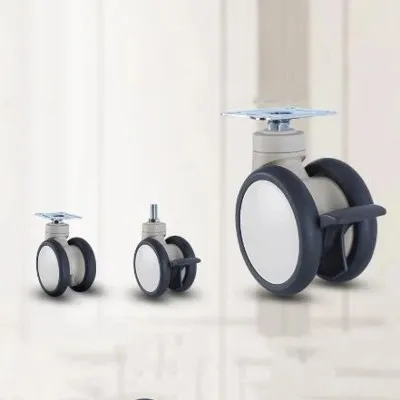

A caster is a non-powered wheel designed to be mounted on the bottom of a larger object and used to move it. Casters are used in shopping carts, office chairs, medical beds and material handling equipment. Caster variations vary widely depending on application requirements and are used in a wide variety of applications. It is an excellent mover with properties such as strength, corrosion resistance, water resistance, and weather resistance. The application of casters requires precise sizing based on the terrain they will be used on and the weight they are expected to carry. Heavy items will require casters with thicker wheels, and some larger items may require multiple wheels to evenly distribute the weight.
Caster parts
Casters usually have six parts: mount, spring, yoke, axle bolt, wheel, and wheel bearing.
● The mount secures your items and consists of two parts: the top plate and the pole.
● In many cases, casters have shock-absorbing properties provided by springs. The spring acts as a cushion when you apply a load to the caster.
● The yoke provides the frame for the wheel and is usually welded or screwed to the mount.
● The axle bolt secures the wheel to the yoke.
● Casters cannot be made without wheels, which are usually solid or bonded. The wheels provide movement for the casters.
● Wheel bearings are small metal pieces around the wheel that are connected using a metal ring called a race.
Typically, caster manufacturers produce all of these parts (except springs and axle bolts) in their factories. Manufacturers typically purchase these parts from suppliers.


Metal plate cutting process
The first board to cut is the top board. This is a plate used to mount casters underneath objects, such as industrial carts. The process starts with a thick plate of steel, cut by a CNC (a computer-guided machine that combines oxygen and electricity to create a plasma). Plasma cutting is a type of thermal cutting that uses ionized gas to cut metal. This means that the process uses heat to melt the metal rather than mechanically cutting it. This is one of the most common methods for cutting thick sheet metal, but it also works on sheet metal. This method is very accurate and fast when cutting steel plates.
The next part to cut is the fork. The forks are the arms that hold the sides of the wheel axle in place. The forks are made from coiled steel, which is a more flexible, thinner steel. The steel coil is rolled out and fed into a punch press, which breaks it along with the yoke dye. The broken yoke is placed on the forming press. The press bends the workpiece into the desired shape and creates a circular groove around the hole in the center. The hole is filled with steel ball bearings, allowing the yoke to rotate. Steel retainers are installed to hold the ball bearings in place. The grooves of the steel cover are also filled with ball bearings, which are then placed on the punch and the yoke is placed on top. The press attaches the cover to the yoke's retainer, sandwiching the ball bearing. After the top plate is riveted to the yoke, the steel seal is placed on the retainer and locked in place with a pneumatic press.
Rubber or nylon extrusion
The next processing step in caster production is the extrusion of the wheel material. To make the wheels, nylon inserts are needed. The insert is placed in an injection molding machine, which melts the neoprene and injects it into the mold. Once cooled to a solid state, the machine pops off rubber-sided wheels. Rubber edges absorb impact, reduce noise and prevent damage to floors or surfaces.
For larger wheel sizes, different forming machines are used to accommodate the required size. The molding process used to produce wheels is the same. These larger molding machines typically only produce one wheel at a time. After the wheel pops out of the molding press, place it on a cooling rack for two and a half hours. The wheel mold consists of two parts that once connected form a sim. Then grind the rubber SIM until the surface is smooth.
Parts assembly
The two-part bearing is placed inside the wheel and locked into place with a pneumatic press. Steel rails are then installed on both sides of the wheel. Steel rails prevent anything from getting into the wheels and inhibiting their movement. Steel rails position the wheels between the yokes and insert the steel axles. The bolt head secures one end and the nut connects to the other end. Inject grease to lubricate ball bearings.